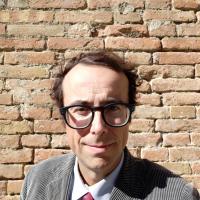
Matteo Gerlini is Associate Professor of History of International Relations at the University of Siena, where he is Vice Director of the Department of Political and International Sciences. He works on the history and politics of security and of scientific and technological cooperation, with particular attention to emerging technologies. His The Nuclear Politics of the Middle East: The Crisis of Proliferation, Control and Diplomacy is forthcoming with Bloomsbury: a history of the Middle Eastern nuclear question read through international technological cooperation.
He lectures on the history of EURATOM safeguards in the annual ESARDA course and in the Politecnico di Milano’s Master in International Nuclear Safeguards, and coordinates the University of Siena’s part in the nuclear security training project of the OECD Nuclear Energy Agency’s NEST programme, whose NextGen Nuclear Leaders Summer School he taught at in 2026. He presented the Italian case at the Agency’s Fourth Stakeholder Involvement Workshop. He has chaired the International Nuclear Security Education Network, the IAEA’s academic partnership, and sits on the evaluation panel of the NATO Science for Peace and Security Programme.
He coordinates the University’s adoption of the recommendations of the OSCE High Commissioner on National Minorities on contested histories, which led to the Siena Recommendations of June 2026, and directs the Artificial Intelligence and Governance laboratory (IAGo) of the University’s AI network.
He trained at the “Cesare Alfieri” under Ennio Di Nolfo, working on the history of Italian foreign policy and on nuclear proliferation. He has taught the history and policy of scientific research at the Special School for Archivists and Librarians of Sapienza University of Rome; he was a visiting fellow at the Alcide De Gasperi Centre of the European University Institute, where he carried out two European Commission projects on the history of the Joint Research Centre and of its Ispra site; and he was a Taiwan Fellow in 2020. He has worked with Universitat Pompeu Fabra and the University of Maryland, and has lectured at Keio University.